

Vienna's Hydrogen Bus Supply Crisis Highlights Risks for Transit Agencies
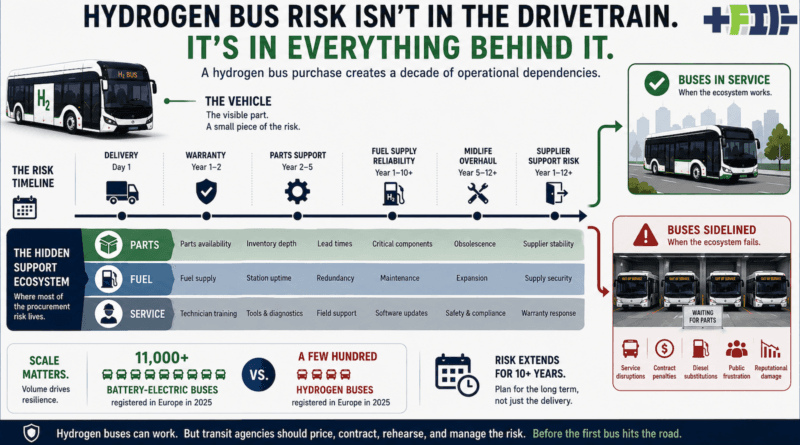
Vienna's hydrogen bus program encountered significant service disruptions when seven of ten CaetanoBus hydrogen buses entered service in December 2025 but were sidelined by May 2026 awaiting repairs for components including door compressors and blind-spot monitoring systems.
According to reports from Wiener Linien and local media, only three buses remained operational while the remaining seven were idled at the Leopoldau depot, with diesel buses temporarily covering the route. CaetanoBus acknowledged contractual penalties and responsibility for restoring parts availability.
The incident underscores a critical procurement lesson: transit agencies purchase reliable service, not just drivetrains. When buses cannot be dispatched—regardless of the component failure—scheduled service suffers.
The case reveals fundamental challenges in hydrogen bus support ecosystems. Europe registered over 11,000 battery-electric buses in 2025 compared to only a few hundred hydrogen buses, creating significant volume differences in parts availability, technician training, and service infrastructure. This disparity leaves hydrogen bus operators with fewer trained technicians, limited parts circulation, reduced supplier leverage, and limited fleet examples to learn from.
CaetanoBus's financial condition compounds the risk: the manufacturer reported negative EBITDA and pre-tax losses of €8.2 million in 2024, worsening to €9.2 million in the first half of 2025. For transit agencies, procurement is a decade-long operating relationship requiring sustained parts supply, software support, and field engineering. A small supplier with weak margins in a niche segment creates substantial operational risk.
The analysis emphasizes that successful transit procurement requires evaluating not just vehicle specifications but entire supplier ecosystems, financial stability, and long-term support capabilities.
Originally reported by CleanTechnica. Read the full article →