

UNSW Sydney Research Achieves 75% Power Output Increase in Redesigned Fuel Cells
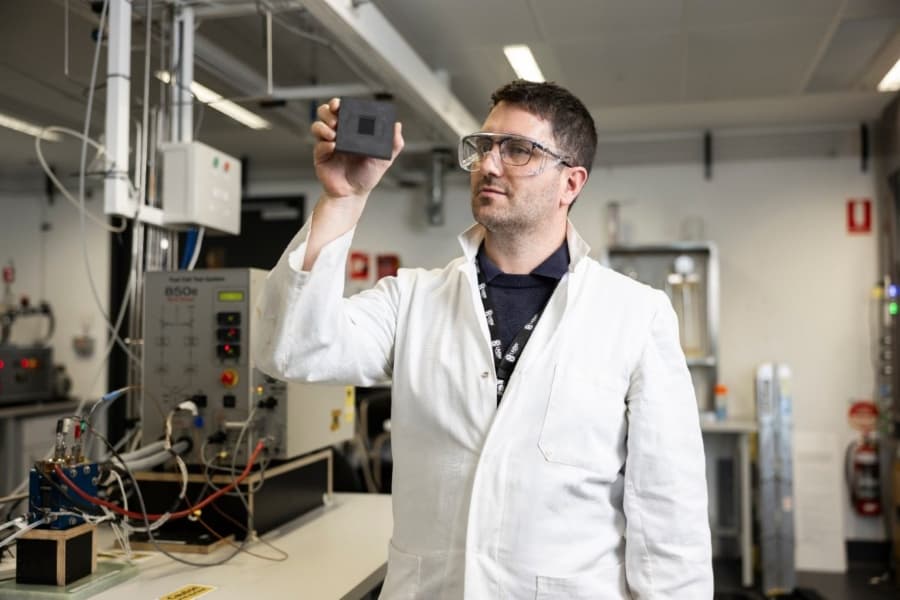
A multidisciplinary team at UNSW Sydney has successfully redesigned fuel cell architecture to address water accumulation problems that have hindered commercialization. The innovation adds 100 µm-wide microscopic channels separated by 100 µm micro-ribs to the fuel cell's internal structure, allowing excess water and gas to escape before blockages can form and reduce oxygen flow.
Led by Quentin Meyer and Chuan Zhao from the School of Chemistry, the research team included contributors from the School of Civil and Environmental Engineering and the School of Minerals and Energy Resources Engineering. Using advanced imaging, fluid flow simulations, and precision micro-engineering, they developed what they call "lateral bypasses" that function as escape routes for trapped water.
The redesigned fuel cells deliver 75% more power than traditional designs while reducing reliance on costly metals such as platinum. The researchers report that the changes also lower overall system weight and cost, addressing longstanding barriers to widespread adoption.
Meyer stated the design achieves improved efficiency "with only minor structural changes." The lateral bypass technology has been patented by Meyer and Zhao, with the team now focused on scaling the technology.
The researchers are initially targeting low-altitude aircraft applications, where they indicate hydrogen fuel cell systems can already provide significantly longer flight times than battery alternatives. Additional potential applications include freight transportation.
Originally reported by Hydrogen Tech World. Read the full article →