

UNSW Research Demonstrates Stability Control for Standalone Solar-Electrolyzer Systems Without Battery Storage
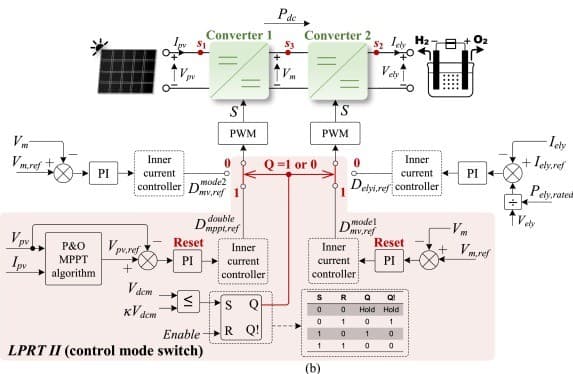
Researchers at the University of New South Wales (UNSW) Sydney have developed novel control strategies for standalone photovoltaic-electrolyzer (PVEC) systems that address power stability challenges during sudden drops in solar output.
The study compared single-stage and dual-stage converter architectures for connecting PV arrays to electrolyzers. While single-stage systems offer simplicity, dual-stage architectures with an intermediate DC link provide greater control flexibility and system stability under variable solar conditions.
The research proposed two low-power ride-through (LPRT) strategies: current-reference reduction and control-mode switching. These methods prevent DC-link voltage collapse during solar deficits by either reducing electrolyzer current to match available PV power or switching operating modes, eliminating the need for battery storage.
Experimental validation using a 200 W laboratory prototype with a gallium nitride converter confirmed simulation results. The dual-stage system maintained hydrogen production of 0.58–1.01 Nm³/h with electrolyzer efficiency of 96.75%–97.12% during 50% irradiance reductions. Control-mode switching stabilized the system in less than 0.5 seconds.
Key findings include the counterintuitive result that electrolyzer efficiency increases as input power decreases. The researchers concluded that while single-stage converters suffice for small systems, dual-stage architectures become essential for scaling to industrial levels.
Future work will focus on integrating hybrid energy storage systems and exploring isolated converter topologies for hundred-kilowatt-scale applications.
Originally reported by PV Magazine. Read the full article →