

Taisei Corporation Demonstrates Year-Round Solar Building Operation Using Hydrogen-Battery Hybrid Storage
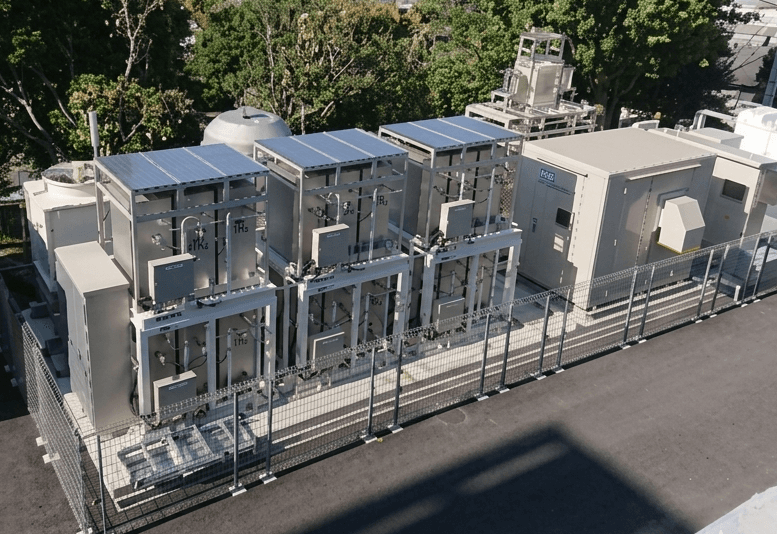
Taisei Corporation has demonstrated a building operating entirely on solar power through a hybrid energy storage system combining photovoltaic generation, lithium-ion batteries, and low-pressure hydrogen storage at its Zero Energy Building (ZEB) test facility in Yokohama, Japan.
The system uses an energy management system (EMS) that coordinates short-term battery storage with long-term hydrogen storage for seasonal energy shifting. The facility includes two 450 kWh lithium-ion batteries, a 5.0 Nm³/h proton exchange membrane (PEM) electrolyzer, a 2,000 Nm³ hydrogen tank, and a 5 kW fuel cell.
During operation since winter 2023, the EMS directs surplus solar power to building consumption, battery charging, or hydrogen production via the electrolyzer. When solar generation is insufficient, stored energy is supplied from batteries or through hydrogen fuel cells.
Performance data shows the system's capability across seasons. On a sunny June 2024 day with 12.1 hours of sunlight, the system generated 444 kWh, with 232 kWh converted to hydrogen for storage. On a winter day in February 2025 with reduced daylight, the system generated 297 kWh, using 168 kWh from stored hydrogen to meet evening and early morning demand.
Taisei plans to further optimize the EMS and hybrid storage system efficiency to establish a fully optimized framework for year-round renewable building operation. The company is also participating in broader hydrogen supply chain demonstration projects across Japan's energy system.
Originally reported by PV Magazine. Read the full article →