

Hyundai E&C Develops South Korea's First Flat-Bottom Liquid Hydrogen Storage Tank
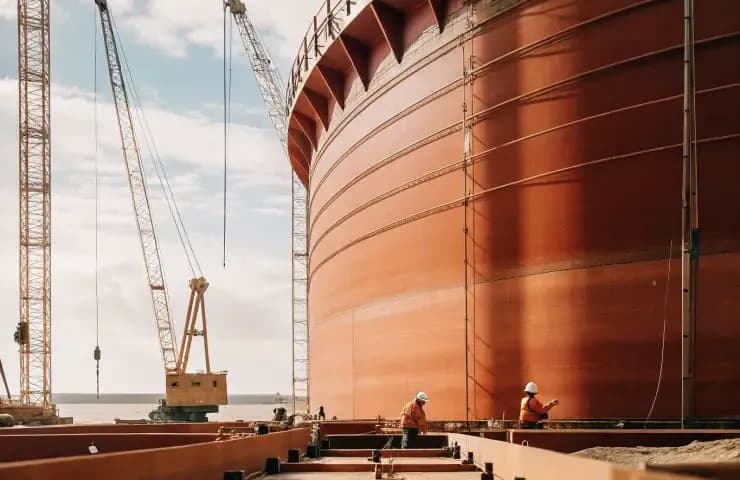
Hyundai E&C has unveiled South Korea's first flat-bottom liquid hydrogen storage tank, marking a significant development in the country's hydrogen infrastructure. The tank is designed to store hydrogen at approximately −253 °C using layered insulation and vacuum gaps to minimize heat transfer and boil-off losses.
The flat-bottom design offers several advantages over traditional spherical or cylindrical tanks. It reduces construction complexity, lowers support structure requirements, and improves usable storage volume. The design also simplifies welding and assembly while reducing material costs. Hyundai E&C is utilizing finite element analysis to evaluate thermal contraction and pressure variations at cryogenic temperatures, drawing on 40 years of engineering expertise and experience with liquefied natural gas terminals.
Given South Korea's location in a seismic zone, the tank design incorporates enhanced structural resilience to withstand earthquakes. The demonstration phase includes comprehensive testing with thermal sensors and stress gauges to validate performance before full-scale production.
This development aligns with South Korea's Hydrogen Economy Roadmap, which aims to produce over 5 million tons of hydrogen annually by 2040, with one-third from renewable sources. Successful deployment of this flat-bottom tank could enable cost-effective liquid hydrogen transport across land and sea, supporting both domestic industrial applications and potential export markets.
Hyundai E&C is collaborating with government agencies and research institutes on safety protocols and performance benchmarks. The company plans to shift from design to on-site assembly in coming months, with trial fills and performance evaluations scheduled before potential full-scale construction.
Originally reported by Hydrogen Fuel News. Read the full article →